
Article · Vitamins & Ingredients
Biotin and Collagen for Hair: What the Evidence Shows
The short answer
Research on biotin and collagen for hair is thinner than the marketing around collagen and biotin supplements suggests. For biotin, there are few high-quality studies in people without a deficiency, and some newer research tests specific formulas that cannot show what ordinary biotin does on its own. For collagen, the most consistent findings concern skin, and even those are mixed. Results for skin or nails do not show that hair grows back. Eating enough food does not automatically mean every nutritional need is being met. A clinician can say whether a shortfall is likely for you, which is a better starting point than guessing with a gummy. Here’s what each ingredient is, the difference between biotin and collagen, what the studies measured, and where the evidence stops.
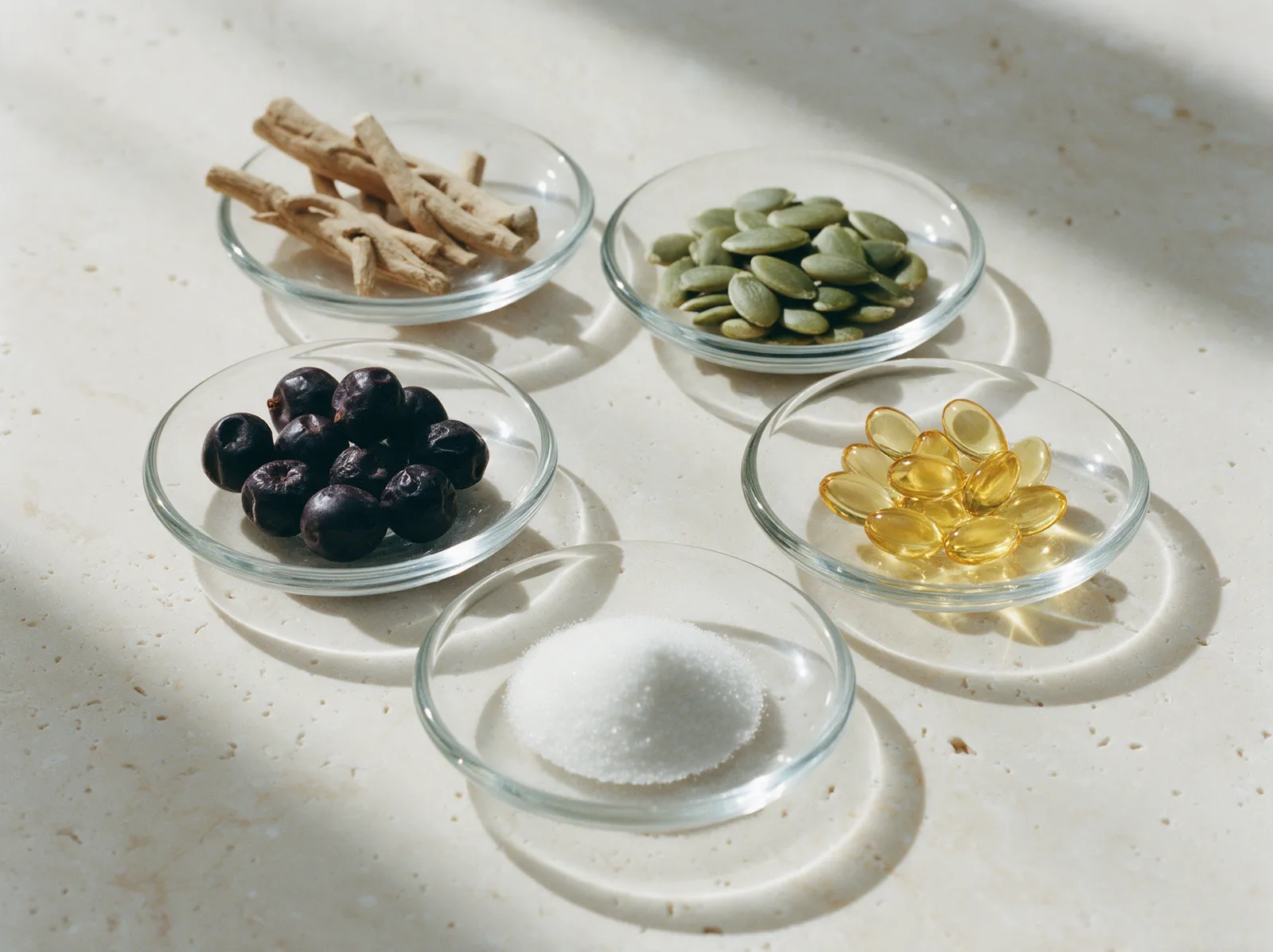
What biotin does and where it comes from
Biotin is a water-soluble B vitamin that helps enzymes involved in fatty acid and amino acid metabolism. Food supplies it, and the NIH Office of Dietary Supplements reports that average intake from food in other Western populations is about 35 to 70 micrograms a day, against an adequate intake of 30 micrograms for adults. True biotin deficiency is uncommon in people who eat a varied diet. It is documented in rare situations, such as inherited enzyme disorders, where a clinician would be involved.
What is the difference between biotin and collagen?
The difference between collagen and biotin is significant. Biotin is a water-soluble B vitamin, and oral collagen supplements usually contain hydrolyzed collagen peptides, which are collagen broken into small fragments. Biotin is dosed in micrograms to milligrams and collagen in grams. The two are different kinds of ingredients with different jobs in the body, and the different amounts say nothing about whether taking them together helps hair.
What the research says about biotin and hair
A 2024 review in the Journal of Clinical and Aesthetic Dermatology searched PubMed on June 6, 2023, and found three qualifying studies of biotin for hair. Its authors concluded that the usefulness of biotin as a hair supplement is not supported by high-quality studies. The one placebo-controlled trial it describes was published in 1966 and followed women with diffuse hair loss who took 10 mg of biotin daily for four weeks, finding no significant difference in hair growth against placebo. That review stopped searching in mid-2023, covered only a few studies, and did not test healthy consumers, so it is not the full current picture.
Newer research has tested specific formulas. A 2025 randomized, placebo-controlled trial gave adults aged 20 to 60 a botanical extract (Sesbania grandiflora) standardized to 1.25 mg of biotin for 90 days and reported improvements in some hair measures. Because the product was a botanical extract, and an employee of the ingredient's supplier was among the authors, the trial cannot isolate what ordinary biotin does or show that routine biotin supplements help. A 2024 crossover study in men gave 10 healthy men 5 mg of biotin a day for 14 days and found no increase in how fast hair grew, though a study that small and short cannot settle the question.
Taken together, the evidence for ordinary biotin in people without a deficiency is limited rather than settled, and the newer formulation research does not change that for the biotin supplements most people buy.
What the research says about collagen
Oral collagen supplements usually contain hydrolyzed peptides, which are collagen broken into small fragments that the gut absorbs. Most of the research measures skin. Meta-analyses of randomized trials report better skin hydration and elasticity in some analyses, but the results are mixed: a 2025 meta-analysis by Myung and Park found the benefit shrank or disappeared in trials without pharmaceutical funding and in higher-quality trials. A 2023 meta-analysis by Pu and colleagues pooled randomized trials with a more positive result, and its authors called for larger randomized trials.
Hair is measured far less often. The clearest hair data come from one 2024 randomized, double-blind, placebo-controlled trial funded by the product's maker (Reilly et al.). It randomized 138 adults, and 130 completed 12 weeks of marine collagen (8,000 mg) with vitamin C (60 mg), taken daily or every other day. Several skin measures improved against placebo. Hair was assessed with scalp imaging in only a small subgroup of 11 people taking the daily product and 13 taking placebo. In the daily group, total hair count rose by an average of 33.4 hairs per square centimeter from baseline, which the paper reports as 27.6% more than placebo, a difference that was not statistically significant. Expert graders also rated hair appearance as healthier in the daily group (a 31.9% improvement against 9.4% with placebo), but an appearance rating is not a measure of hair growth.
After week 12, participants stopped the supplement, and a group of 32 returned at week 20. Hydration, elasticity, and wrinkle measures had slipped back toward their starting values. The paper reports no placebo comparison for that follow-up, so it cannot show that stopping the supplement caused the change. It is also part of the same study, so it is not independent confirmation of the first 12 weeks.
The doses used in trials such as this one are study doses. They are not dietary requirements, and the trial does not show that anyone needs collagen.
Biotin vs collagen: hair, nails, and skin at a glance
Outcome | Biotin | Collagen | Main limit |
|---|---|---|---|
Hair | A review that searched through June 2023 found no high-quality support. A 2025 trial of a botanical biotin formula could not isolate ordinary biotin. | One company-funded trial measured hair in a small subgroup. The hair-count change was not statistically significant. | Hair evidence is sparse for both ingredients. |
Nails | Small uncontrolled reports are summarized by the NIH. | A 25-person open-label study of one branded collagen peptide product (Hexsel et al.) reported improvement. | Neither had a placebo group, so neither shows an effect. |
Skin | No high-quality trials were found in the sources reviewed. | Some meta-analyses report better hydration and elasticity, with mixed results by funding and trial quality. | Skin results do not show hair growth. |
Does combining biotin and collagen help?
Collagen with biotin in one gummy or powder combines the ingredients and does not combine their evidence. The biotin and collagen research was done separately, in different groups of people, measuring different outcomes. No study reviewed for this article tested collagen and biotin together for hair.
A multivitamin with biotin and collagen is one kind of combined product, but not every combined product is a multivitamin, and the full ingredient list on the label shows what a product actually contains, including whether it has biotin.
Biotin and blood tests
Biotin can interfere with some laboratory tests. The FDA has warned that biotin can cause incorrect results that may go undetected, including falsely low troponin results. Studies in adults taking 10 mg of biotin a day found interference with certain immunoassays, including some thyroid tests, depending on the test platform (Li et al., JAMA; Ylli et al.). The effect depends on the specific test and lab, not on every blood test.
Tell your clinician and the lab about every supplement you take before a blood draw. Whether to pause biotin beforehand depends on the test, so ask them rather than following a general rule. Check the full formula of any collagen product too, in case it includes biotin.
When to see a clinician
Sudden, patchy, painful, or scarring hair loss, or hair loss that starts during pregnancy, nursing, or after a new prescription medication, deserves a direct evaluation. A clinician can decide whether any tests are useful for you. Skin and nail results from supplement studies do not substitute for that evaluation, and hair changes are slow to see, so a supplement cannot be judged quickly. If you have concerns or side effects, that is a reason to ask for advice and not a reason to keep taking a product for months.
Frequently asked questions
If I already eat well, will taking more biotin help my hair grow?
The research reviewed here does not show that extra biotin helps hair in people without a deficiency. The one placebo-controlled trial in a 2024 review found no difference from placebo, and newer formulation research cannot isolate ordinary biotin. Many diets supply more than the 30 microgram adequate intake, but a clinician can say whether a shortfall is likely for you.
Does collagen help hair growth?
Collagen research has focused on skin, with mixed results, and skin findings do not show hair growth. In the one randomized trial that measured hair in a small subgroup, the hair-count change was not statistically significant, although expert-graded appearance was rated higher. Appearance ratings and hair growth are different outcomes.
Do biotin or collagen help brittle nails?
The evidence is limited. The NIH summarizes small uncontrolled reports for biotin, and the collagen study was a 25-person open-label study of one branded product. Neither had a placebo group, so neither shows that the ingredient caused the improvement.
Is biotin the same as collagen?
No. Biotin is a water-soluble B vitamin, while collagen supplements usually contain hydrolyzed collagen peptides, and the two are dosed in different amounts. Putting them in the same product does not combine their evidence for hair.
Can biotin affect my blood tests, and should I stop it before labs?
Biotin can interfere with certain laboratory tests, including some troponin and thyroid tests, according to the FDA and the studies cited above. Whether to pause it depends on the test and the lab, so tell your clinician and the lab about every supplement you take and follow their advice.
Sources
All pages accessed October 13, 2026 (CosmeticsDesign, October 12, 2026).
NIH Office of Dietary Supplements. Biotin: Fact Sheet for Health Professionals. Updated January 10, 2022. Sections on intakes, deficiency, and hair, nail and skin health.
Yelich A, Jenkins H, Holt S, Miller R. Biotin for hair loss: teasing out the evidence. J Clin Aesthet Dermatol. 2024;17(8):56–61. PMID 39148962.
Patel MN, Maheshvari J, Patel N. The role of Sesbania grandiflora-derived biotin and Bambusa arundinacea-derived silica extracts in promoting hair, skin, and nail health: a randomized, double-blind, placebo-controlled clinical study. Cureus. 2025;17(7):e89118. doi:10.7759/cureus.89118.
Valentim FO, Miola AC, Miot HA, Schmitt JV. Efficacy of 5% topical minoxidil versus 5 mg oral biotin versus topical minoxidil and oral biotin on hair growth in men: randomized, crossover, clinical trial. An Bras Dermatol. 2024;99(4):581–584. doi:10.1016/j.abd.2023.07.008.
Myung SK, Park Y. Effects of collagen supplements on skin aging: a systematic review and meta-analysis of randomized controlled trials. Am J Med. 2025;138(9):1264–1277. doi:10.1016/j.amjmed.2025.04.034. Abstract only.
CosmeticsDesign. Industry pushes back on meta-analysis concluding collagen supplements show no benefit for skin aging. August 26, 2025. Trade press reporting industry commentary.
Pu SY, Huang YL, Pu CM, et al. Effects of oral collagen for skin anti-aging: a systematic review and meta-analysis. Nutrients. 2023;15(9):2080. doi:10.3390/nu15092080.
Reilly DM, et al. A clinical trial shows improvement in skin collagen, hydration, elasticity, wrinkles, scalp, and hair condition following 12-week oral intake of a supplement containing hydrolysed collagen. Dermatology Research and Practice. 2024. doi:10.1155/2024/8752787. Funded by Absolute Collagen.
Hexsel D, et al. Oral supplementation with specific bioactive collagen peptides improves nail growth and reduces symptoms of brittle nails. J Cosmet Dermatol. 2017. doi:10.1111/jocd.12393. Abstract only.
U.S. Food and Drug Administration. Biotin Interference with Troponin Lab Tests – Assays Subject to Biotin Interference. Content current as of June 21, 2022.
Li D, Radulescu A, Shrestha RT, et al. Association of biotin ingestion with performance of hormone and nonhormone assays in healthy adults. JAMA. 2017;318(12). A published correction fixes a unit of measure and doesn't affect the claim used.
Ylli D, et al. Biotin interference in assays for thyroid hormones, thyrotropin and thyroglobulin. Thyroid. 2021;31(8):1160–1170. doi:10.1089/thy.2020.0866.
This article is for education only and is not medical advice. Talk with your healthcare provider about your own hair and scalp health.
Key takeaways
- Biotin is a water-soluble B vitamin, and oral collagen supplements usually contain hydrolyzed collagen peptides.
- No study reviewed for this article tested collagen and biotin together for hair.
- Tell your clinician and the lab about every supplement you take before a blood draw.
- Sudden, patchy, painful, or scarring hair loss deserves a direct evaluation.
Related from the Learning Hub
Biotin Gummies: What Higher Doses Mean for Hair and Lab Tests
Higher-dose biotin gummies have no established hair benefit in people who are not biotin deficient, and the research behind biotin for ordinary shedding is limited. Biotin supplements can also interfere with some blood tests, which is the part worth knowing before your next blood draw. This article covers what the numbers on a label mean, what studies show, and what to tell your clinician and lab.
 4 min read
Rosemary Oil for Hair: What the Research Says
Does rosemary oil grow hair? Research on rosemary oil for hair is limited to one small human study. That six-month trial included men with pattern hair loss, a 2024 dermatology review reports. Doctors aren't sure how rosemary oil might affect hair, UPMC notes.

