
Article · Vitamins & Ingredients
Rosemary Oil for Hair: What the Research Says
The short answer
Does rosemary oil grow hair? Research on rosemary oil for hair is limited to one small human study. That six-month trial included men with pattern hair loss, a 2024 dermatology review reports. Doctors aren't sure how rosemary oil might affect hair, UPMC notes.
What is rosemary oil?
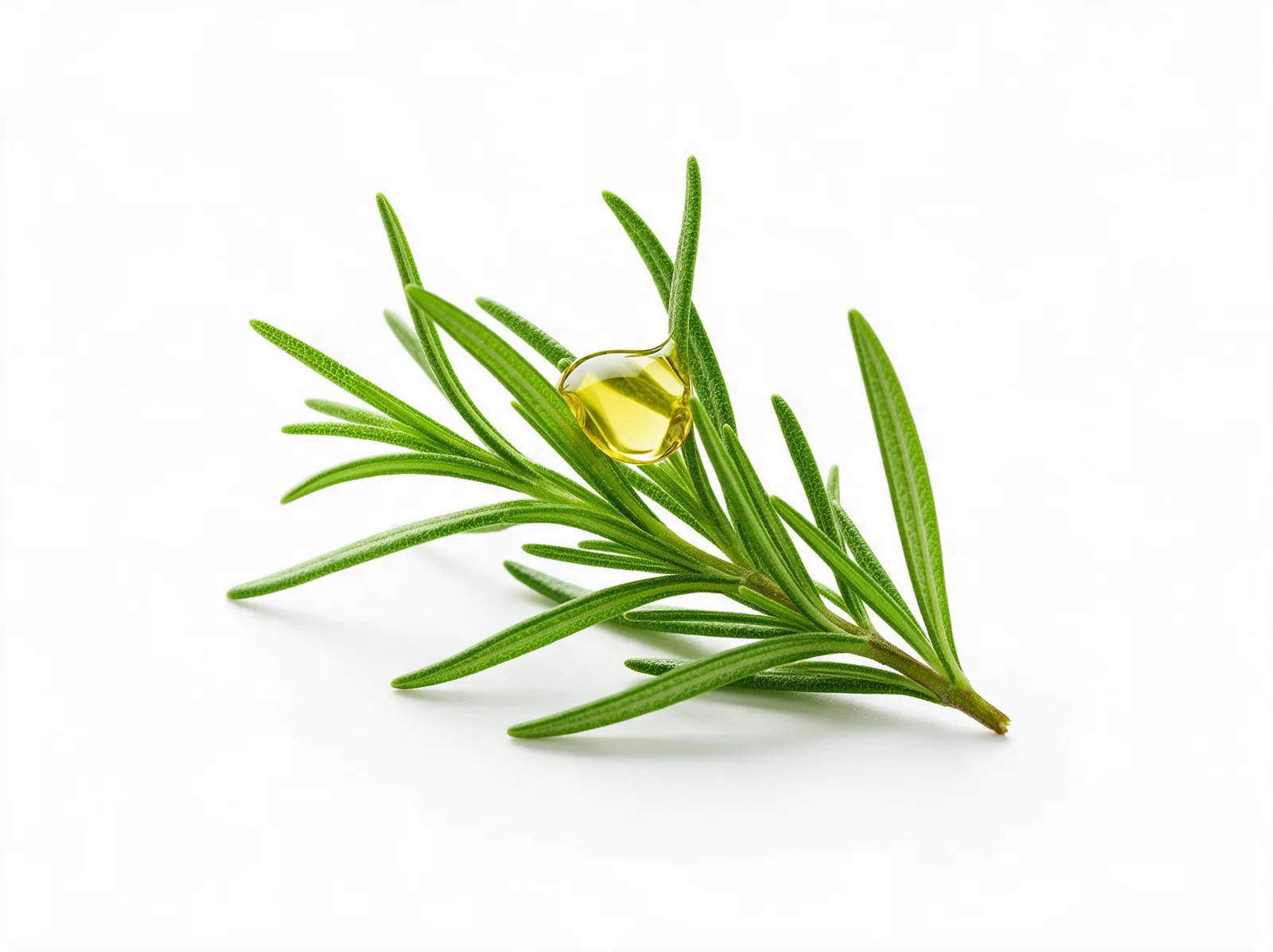
Rosemary grows as a shrub around the Mediterranean, and the essential oil sold for hair is drawn from its fresh leaves and twigs, UPMC explains. Essential oils are fragrant plant extracts, and a single one can hold more than 100 compounds, according to DermNet.
What does the research say about rosemary oil for hair loss?
The 2024 review says the trial ran in 2015 and randomly assigned 100 men aged 18 to 49 with androgenetic alopecia, the medical name for pattern hair loss. The trial's other group used minoxidil, which the review notes is one of only two medicines the FDA has approved for that condition.
Women weren't included, and the same review notes that pattern hair loss looks different in them: they usually keep their front hairline but thin over the front and center of the scalp. The role of androgens in women's pattern hair loss is also less clear, the review adds.
Why are researchers studying rosemary for hair?
In one study of 300 scalp biopsies from people with pattern hair loss, nearly half showed a buildup of immune cells around the follicles, the 2024 review reports. That finding is why the review's authors see compounds in rosemary that they describe as anti-inflammatory, such as carnosic acid, as worth studying.
What doesn't the research tell us yet?
The best dose and way to apply rosemary oil still haven't been worked out, the 2025 review says. The 2019 review adds that over-the-counter herbal products lack standardized amounts of their active ingredients. A Cleveland Clinic dermatologist says the evidence is still limited.
What are the side effects of rosemary oil on hair and scalp?
Because rosemary oil is concentrated, Cleveland Clinic and UPMC suggest mixing it with a carrier oil, such as coconut or jojoba oil. Putting undiluted essential oils straight on the skin can lead to an allergy, DermNet warns. A reaction can bring itching, redness and scaling, generally 24 to 72 hours after contact, DermNet adds.
Overusing rosemary oil may cause scalp irritation, redness, burning, inflammation or damaged hair follicles, according to Cleveland Clinic. That matters: the 2019 review points out that alternative hair loss products may inflame the scalp and lead to more hair loss.
A few other cautions:
Test a small area of scalp first, particularly for people with fine hair or atopic dermatitis (Cleveland Clinic).
If you add it to shampoo, choose a gentle, fragrance-free one, since fragrance can raise the risk of irritation (Cleveland Clinic).
Keep it out of your eyes, where it can be irritating (UPMC).
Rosemary oil isn't recommended during pregnancy or breastfeeding (Cleveland Clinic).
When to talk to a doctor
A receding hairline, a bald spot or overall thinning can signal more than everyday shedding, UPMC notes, and a dermatologist can help figure out why. The 2025 review suggests running any herbal remedy past a healthcare professional first. If your scalp gets irritated, Cleveland Clinic says to stop using the oil and see a dermatologist.
Sources
Cleveland Clinic (expert source: Shilpi Khetarpal, MD, dermatologist). Rosemary Oil for Your Hair: How It Works. Cleveland Clinic Health Essentials; January 16, 2026. Accessed October 15, 2026.
Bin Rubaian NF, Alzamami HFA, Amir BA. An Overview of Commonly Used Natural Alternatives for the Treatment of Androgenetic Alopecia, with Special Emphasis on Rosemary Oil. Clinical, Cosmetic and Investigational Dermatology; 2024;17:2495–2503. Accessed October 15, 2026. DOI: 10.2147/CCID.S470989. PMID: 39524109.
UPMC HealthBeat. Will Rosemary Oil Help My Hair Grow? UPMC; March 11, 2024. Accessed October 15, 2026.
Ismail FF, Nixon RL. Allergic contact dermatitis to essential oils. DermNet; January 2020. Accessed October 15, 2026.
Hosking AM, Juhasz M, Atanaskova Mesinkovska N. Complementary and Alternative Treatments for Alopecia: A Comprehensive Review. Skin Appendage Disorders; 2019;5(2):72–89. Accessed October 15, 2026. DOI: 10.1159/000492035. PMID: 30815439.
Ahmed A, Alali AM, Abdullah E, Alharbi MN, Alayoubi HM. Herbal Remedies for Hair Loss: A Review of Efficacy and Safety. Skin Appendage Disorders; 2025;11(4):360–371. Accessed October 15, 2026. DOI: 10.1159/000542876. PMID: 40771449.
This article is for education only and is not medical advice. Talk with your healthcare provider about your own hair and scalp health.
Key takeaways
- The best dose and way to apply rosemary oil still haven't been worked out, a 2025 review says.
- Because rosemary oil is concentrated, Cleveland Clinic and UPMC suggest mixing it with a carrier oil, such as coconut or jojoba oil.
- Test a small area of scalp first, and if your scalp gets irritated, stop using the oil and see a dermatologist (Cleveland Clinic).
- Rosemary oil isn't recommended during pregnancy or breastfeeding (Cleveland Clinic).
Related from the Learning Hub
Biotin Gummies: What Higher Doses Mean for Hair and Lab Tests
Higher-dose biotin gummies have no established hair benefit in people who are not biotin deficient, and the research behind biotin for ordinary shedding is limited. Biotin supplements can also interfere with some blood tests, which is the part worth knowing before your next blood draw. This article covers what the numbers on a label mean, what studies show, and what to tell your clinician and lab.
 10 min read
Biotin and Collagen for Hair: What the Evidence Shows
Research on biotin and collagen for hair is thinner than the marketing around collagen and biotin supplements suggests. For biotin, there are few high-quality studies in people without a deficiency, and some newer research tests specific formulas that cannot show what ordinary biotin does on its own. For collagen, the most consistent findings concern skin, and even those are mixed. Results for skin or nails do not show that hair grows back. Eating enough food does not automatically mean every nutritional need is being met. A clinician can say whether a shortfall is likely for you, which is a better starting point than guessing with a gummy. Here’s what each ingredient is, the difference between biotin and collagen, what the studies measured, and where the evidence stops.

